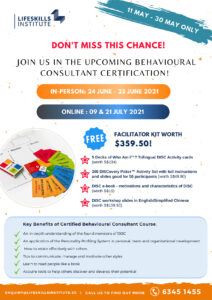
Read more about this certification here.
Promotion is valid from 11 – 30 May.
Click here to Register Today!!!
Read more about this certification here.
Promotion is valid from 11 – 30 May.
Click here to Register Today!!!

“What do you want to be when you grow up?” – A frequent question through our adolescent years. While usually asked in an unassuming way, youths are becoming increasingly invested in planning out their career paths at a young age. The challenge – many are at loss on how to start their journey of self-discovery.
At Lifeskills Institute, we guide students with the first step of learning more about their unique personalities.

Our DISC profiling tool provides a common language that one can use to develop self-awareness by identifying their Dominant, Influencing, Steady or Compliant personality traits. This offers us a glimpse into the kind of work that we would find most engaging. This clarity at a young age enables students to gain a competitive advantage by tapping into their strengths and acknowledging their weaknesses. This additionally builds upon their self-confidence as they navigate through their developmental years.

Students at AIPS were fascinated by the DISC tool which empowered them to understand what makes them uniquely different. Every class was coupled with our team of passionate trainers and facilitators who played an integral part to help students with their personal growth through experiential learning, educational activities and quizzes.
 Quicksand, Fireball and Build a Tower were three activities Lifeskills selected for students to challenge themselves, think outside the box and thrive in a team setting. A blend of videos and audio clips were used to appeal to our visual and auditory learners by keeping them engaged in learning.
Beyond identifying their personalities, students also explored their motivations along with their preferred learning styles (AVK). The consolidated set of DISC & AVK data would serve helpful to all teachers when it comes to classroom management and guiding individual students along. To conclude, uplifting notes of encouragement were exchanged amongst peers to promote the spirit of camaraderie and cohesiveness in each class.

I was impressed by the entire workshop which had a great balance in incorporating numerous experiential activities and theoretical knowledge which conveys the training session in a beneficial and fun manner. Watching the student’s radiant enthusiasm reminded me of my younger self, who was eternally curious and repeatedly ask the question – WHY. I believe this workshop is a foundational stepping stone for young leaders to kickstart their journey of self-discovery and will go the extra mile in achieving their onward goals.

At Lifeskills, we aim to equip our young leaders to be confident, compassionate and courageous in paving their way forward!
Written by Syahin Insyirah SAK, Business Development Executive (Intern)

A resilient leader is a person who demonstrates the ability to see failures as minor setbacks, with the tenacity to bounce back quickly.
Building resilience is imperative to becoming a leader who can successfully navigate through challenges and guide others with courage and conviction. In a recent study by Zenger Folkman, it was found that leaders with high levels of resilience are viewed as being more effective by their managers, peers, and direct reports. Research shows that firms imbued with resilience don’t just survive, but they thrive in the face of change and uncertainty.
The definition of resilience is the capacity to recover from, or quickly adjust to, difficulties. Some call it toughness. It’s one of the key traits of effective leadership. When faced with ambiguity, a resilient leader finds ways to move forward and avoids getting stuck. Many studies have indicated the importance of resilience as both an individual and a leadership trait.
When leaders have the perseverance to keep going in tough times, they’re better able to transform crises into breakthroughs and accomplish a lot with very little.
Zenger Folkman collected data on more than 500 leaders using an assessment that measures resilience along with nine other leadership competencies. The assessment used ratings from managers, peers, direct reports and others on 40 behaviours. We looked at the impact of leaders who rated highest on resilience (the top 10%) versus those rated at the (bottom 10%). When we looked at ratings of overall leadership effectiveness, it is obvious that the most resilient leaders are viewed as the most effective leaders as well.
The graph below shows the different ratings for the two groups:

Having A Preference For Resiliency
The assessment also consists of a self-assessment survey with a global database of more than 1,300 responses. They collected preference data on a variety of factors including resilience. When they looked at people with a strong preference for resilience, they found they were quick to take action and act independently. The most resilient people were more reactive than thoughtful and more focused on action than relationships. They were also more willing to take risks and make decisions quickly. Being resilient as an individual, and being viewed as a resilient leader, requires that you bring others along with you.
What Can Leaders Do to Demonstrate Resiliency?
To understand the key behaviours that help leaders demonstrate their resiliency Zenger Folkman compared the most resilient leaders to the least on 37 behaviours and selected the top 20 that showed the most significant difference. We then factor analyzed the data and identified 7 factors. We believe that these are enabling behaviours that help individual leaders demonstrate their resilience to others. For a leader who is trying to be more resilient, we believe that improvement on even a few of these factors will help.
Communicate Powerfully: Some individuals will often act individually and not inform others about what they are trying to do. When driving down the freeway, we always appreciate it when people signal before they change lanes. Signalling lets others know your intentions. The most resilient leaders are effective at communicating their intentions to others. They were willing to help others understand a new strategy or direction. Effective communication helps others understand changes, expectations, and new directions.
Are Coachable: Resilient leaders are open to feedback and often asked others for feedback. Once feedback is given they also demonstrate a real effort to improve. They have a strong desire to continuously improve their skills and abilities. These leaders were both humble and coachable. As we look at this skill we see that younger employees are often coachable, but many people become less coachable as they age. The most resilient leaders, however, continue to ask for feedback throughout their careers.
Build Positive/Trusting Relationships: Resilient leadership occurs when people can bring others along. By building trust and being open to differences, these leaders are able to create strong teams by building positive relationships. An individual may be willing to make a dramatic change, but it requires positive relationships to get others to support change.
Are Bold Risk Takers: Resilient individuals are willing to take bold risks and try new ideas. It is easy for most individuals to be stuck in a rut in which they continue to conduct work in the same way from year to year. That approaches works well until the world changes, requiring organizations to change or die. Resilient leaders are not afraid to take risks and make bold changes.
Develop Others: The most resilient leaders were not only interested in their own development but they are concerned about the development of others. Resiliency is needed when we encounter failure. Developing others helps everyone to learn from their mistakes. We continue to find that leaders who want feedback for themselves are more likely to give productive feedback and coaching to others because they want honest feedback as well.
Champion Change: Resilient leaders are willing to change and able to provide the leadership to ensure that the organization will also change. Change takes courage and requires a vision about where the organization is going. Resilient leaders embrace change and also encourage others to change.
Are Decisive: Making decisions is always difficult because no person has all the data or understands all eventualities. But organisations cannot move forward until a decision gets made. The most resilient leaders are effective at making decisions and moving forward. If they make the wrong decision, they are quick to make a different decision and move in another direction. The proverb by Cato “Swift and resolute action leads to success; self-doubt is a prelude to disaster” fits well here.
How To Be More Resilient
Resilient leaders are perceived more positively in an organisation, but it’s sometimes difficult to understand specifically what a leader can do to be viewed as more resilient. The seven characteristics above are the result of research from more than 500 leaders.
When it comes to leaders, being able to implement resilience tools and strategies will not only make you a better leader but help the company overall. Choosing to improve on even a few of these factors will help you to be seen as more resilient.
Article contributed by Joe Folkman

Personal development refers to the development of one’s character, interpersonal skills, the ability to pick up on social cues, and communication abilities. They are important because they allow you to create strategic and tactical plans for personal and professional growth to better achieve your goals.
Developing these skills requires constant self-improvement that is focused on strengthening your knowledge, capabilities, and self-awareness to reach your personal goals both personally and professionally.
Personal skills are also highly transferable, since your attitude, personality, and work style automatically follow you everywhere you go and to any company that you work for. Soft skills can complement your hard skills, making you a well-rounded candidate that will be a positive addition to any team.
The most effective way to hone your personal development skills is to work them into your daily routines by first identifying the areas for development and constantly finding ways to improve them:

These are a few tips on how you can improve on your personal development skills to benefit your life and your work. Focus on developing the skills that will best help you reach your goals.
Personal development is a lifelong process that does not happen overnight. It requires deliberate and consistent effort to bring about truly meaningful change, so give yourself the time and space to grow!
We hope you find these tips useful and applicable. Unlike hard skills, we are unconsciously practicing soft skills all the time, both at work and at home.
Start thinking about where you would like to improve and seek resources to help you achieve your goals!

Many organizations provide individual contributors with technical or hard skills training but put off doing leadership or soft skills training until individuals are promoted into management.
When it comes to those sitting on the lower levels of the corporate ladder, there are many controversial views of the value of developing “soft” skills for the “worker bees”.
Analysis from Zenger Folkman verifies that while individual contributors with hard skills are more valued than those with soft skills, the combination of both soft and hard skills plays a critical role in improving the performance rankings and overall effectiveness of an individual contributor.
For this research, hard skills were defined as:
Soft skills were defined as:

The results below show the overall effectiveness ratings for leaders who were in each of the above groups. As the graph demonstrates, hard skills are more highly valued for individual contributors than soft skills.
There is a significant difference between individual contributors in those two groups (t-value 3.817, Sig. = 0.000). The more meaningful and much more substantial difference is between those who were in the top 25% on both skills and either of the other groups (t-value 34.53, Sig. 0.000 and t-value 33.62, Sig. 0.000.) These leaders were rated on average in the top 10%.
However, when individual contributors were highly skilled at both, 91.6% of those individuals were given the top performance rating.

The above study demonstrates that individual contributors with hard and soft skills are rated as significantly more effective and are substantially more likely to receive high-performance evaluations.
If you are an individual contributor, remember that you can influence and lead those around you. Don’t brush off the soft skills that will advance your career.
Leadership is the ability to influence others, at times, the ability to influence their peers and manager. Individual contributors can be substantially more useful when they possess better interpersonal and leadership skills.
Providing individual contributors with soft skill training early on in their careers provides each person with time, experience, and opportunities to strengthen those soft skills. When they are put into a management position, their level of effectiveness is much higher.
Young leaders are being promoted to mid and senior-level positions quite often. But do they have the necessary skills and training to be great leaders?
Employees in organizations where development opportunities are more plentiful have higher engagement, lower turnover, and higher productivity.
Read on research article here by Jack Zenger that even if an individual contributor does not move into a management position, their performance is improved by soft skill development.
Image credit: Aevo

After watching Pixar’s latest animation movie “Soul” I was captivated by all that goes into what makes a person unique. One’s personality, interests, passion, discovering that spark to life. Before reading on, I must warn you that there are spoilers ahead. If you have not seen the film, it’s best to catch the trailer to get an idea of what we’re about to explore.
The movie follows a Mr Joe Gardner, our main protagonist who navigates through life in hopes for a big break and to achieve his dream as a successful jazz pianist. A drastic turn of events lands him with an unborn soul in “the great before”. Before each soul gets their “earth pass” they each require finding their spark which gives them their personalities, interests and quirks. For some it’s music, for some it’s food, for others, archery, it could be anything!
That’s when I went into existential mode – What is it that gives my life that.. spark?
I translated that into finding my passion. Referencing an assessment I did recently (Behavioural Attitudes Index) I it helped me unravel six dimensions of hidden motivations: I-SPEAK (inner awareness, spirituality/faith, power/political, economical, artistic, knowledge). Considering I always identified myself as someone creative, I expected my highest score to be in the “artistic” realm.
Instead.. “Wendy’s primary style is power/political” came up and I was surprised. Reading on, while I recognised that I have many interests such as music, singing, content creating, it struck me that it was the desire to influence others through my creative work that gave my life meaning!
“Life is full of possibilities. You just need to know where to look.”
While my life was filled with the vibrancy of the creative work I do, I truly only realised this spark/passion quite recently. I found myself thinking “How can I influence someone positively through the content I make?” “How am I displaying my values through my videos”. This eventually lead me to discover my purpose and find meaning in the work I do.
Perhaps the question you can ask yourself, where are you looking?
We are in the business of helping people discover themselves, how about we work together to discover that “spark”?
We got to love how Pixar takes a complicated concept and makes it so easy to relate to and understand. Give it a watch and let me know what you think!
Article Contributed by Wendy, Programme Consultant at Lifeskills Institute
If you love helping people discover what they love – what they want to “be when they grow up,” and help them navigate the changing and increasingly complex job market, then career coaching may be just what you need.
Career Coaching helps individuals identify career resolutions in the areas of job satisfaction, promotion, career opportunity and career planning. A Career Coach comes in from the outside and challenges executives to explore new learnings, honor new perspectives and further develop their capabilities.
According to the Forbes article “10 Things You Should Know About Career Coaching” by Demetrius Cheeks, a career coach helps people make informed decisions about their career trajectory and development. It’s a more solutions-oriented role than that of a mentor because it focuses on concrete steps you can take to achieve your career objectives.
Career Coaching has proven to help Managers, Professionals, Executives and Entrepreneurs that are congruent with their personal goals, ambitions, values and family life.
Key Benefits of Career Coaching
If you’re serious about finding a new job, landing that promotion, or advancing your career, learn to apply principles and practical step-by-step techniques for career coaching and getting started in a career as a professional career coach.
We encourage individuals who are at an inflection point in their career or life and to step back to create a clear vision of the future they want for themselves.
Acquire the mastery of coaching to enable the change to support people in making informed decisions about their career development and trajectory.
For a confidential and complimentary conversation on whether executive career coaching is for you or your organisation, drop us an email/call and our consultants will be in touch to share more. You may find more information on the Certified Career Coaching Course (CCC) here.

Most of us in our lifetime have lived through the Asian Financial Crisis of 1997 and the Great Recession of 2007. Now, we are weathering the impact of Pandemic 2020. In times of uncertainty, we tend to turn much of our attention to the outside world and its changes; looking out for signals or trends to determine our next steps forward.
This, more often than not, causes us to lose sight of some of the things that matter most in our careers. Career Coaches are growing into an invaluable asset to help us draw attention to the inward voice that matters the most. The process of coaching not only serves as a sound reminder, but also draws emphasis to our personal attributes and uniqueness when making those big decisions in life.
Before you embark on this journey of helping others, considering these three-sets as you decide on a career coaching certification course. These are the key takeaways that you will receive from the Certified Career Coaching course (CCC).

We lay foundation to what coaching is all about. Being a Certified Career Consultant goes beyond the definitions of coaching to explore the dispositions and perspectives of an effective coach. This includes the do’s and don’ts of the craft, along with your role as a coach and the impact it brings. In quick summary: coaching is a fully empowered, self-discovery process experienced by the client, to reach an outcome with new insights, choices, and actions.
Through a modular, step-by-step approach, we set you up with the techniques for actual, practical coaching application. You will be familiar and competent to apply the ASPIRE© coaching model to increase your success as a coach. Through real-time demos, practice, and feedback, this will be a hands-on journey to experience coaching in person.
Most unique to CCC, this certification programme incorporates four self-awareness tools and psychometric assessments to help clients uncover their unique career attributes. Your accessibility to a range of tools will differentiate you as a coach, to support them using validated assessments and build confidence in their career pursuits. The toolset enables you to help clients explore their personality, values, skills and passions.
If you’re still wondering if our certification is for you, drop us an email/call and our consultants will be in touch to share more. You may find more information on the Certified Career Coaching course (CCC) here.


The DISC Report report provides a comprehensive overview of the way that people think, act, and interact. It is the most widely used profiling tool of its kind, and is supported by decades of validation and reliability studies. It is best used to help you understand your personality style to enhance communication, strengthen relationships, build strong teams and motivate yourself and others.
Click here to see a sample report.

The Behavioural Attitudes Index (BAI) gauges the underlying passions and motivations of an individual within a specific environment. Behavioural attitudes coincide with the feelings and thoughts that unwittingly mold every choice a person makes.
Click here to see a sample report.

Experience the most powerful and comprehensive assessment tool. By combining DISC Personality Style, TEAMS Thinking Style and Workplace Values assessments into one report (DTV), you will gain insight into the 3 dimensions of one’s personality: behaviour, motivators, and thought
Click here to see a sample report.

By combining the DISC Personality Style, TEAMS, Workplace VALUES, and the Behavioural Attitudes Index (BAI), you can assess 4 different dimensions of personality, behaviour, thought processes, and motivators. Four Online Behavioural Assessments All Rolled Into 1 Thorough and Comprehensive Report!
Employ the most comprehensive and thorough personality assessment on the market today. The Four Dimensions of Personality Report (4D) is a revolutionary new report that offers over 1440 different points of comparison for successful predictive hiring and to generate the most comprehensive personality profile available today.
Click here to see a sample report.
From 16 – 31 December, enjoy our exclusive promotion available this season!
Contact us to purchase this package deal!


360-degree assessments are the backbone of most leadership development programmes. More companies than ever before offer a variety of different 360-degree assessment options, including many talent management systems that provide organisations the ability to build and process their own.
There are many instruments available with apparent similarities but… not all are in the same class as far as quality and effectiveness. We encourage organisations to seriously consider these 11 elements when selecting 360-degree instruments for their development programs.

A 360-degree feedback assessment (also known as multi-rater feedback), is a powerful tool that enables a group of coworkers and managers as well as a self-evaluation to provide feedback about a fellow employee’s performance. By understanding leaders’ current effectiveness, strengths and potential, you can set the stage for organisational success.
Unlike a typical employee performance review in which an employee’s work performance is evaluated by only their manager, a 360-degree review takes into account feedback from co-workers and reporting staff—even other people who have once interact with the employee.
By integrating 360 assessments into their talent management plan, organisations can help identify what’s most important in order to attain their strategic goals. The correct implementation of 360 assessments should improve an organisation’s financial performance, strengthen its existing talent, and enhance its talent pipeline.
Download this white paper to learn the distinctive features and what look for in a 360 survey instrument.
[qode_button_v2 target=”_self” hover_effect=”” gradient=”no” link=”https://lifeskillsinstitute.sg/wp-content/uploads/2020/12/Best-in-Class-360-Assessment-WP-2020.pdf” text=”Download Now” color=”#ffffff” background_color=”#15487d” hover_background_color=”#196a96″]
Page 1 of 8