
Extraordinary Leadership For A New Era
MICROLEARNING SERIES

Leadership Training for Managers
Maximise organisational and team performance by elevating your management team
Leadership Microlearning Experiences for leaders in Singapore and Malaysia to quickly develop critical behaviors for success.
Duration: 1.5 to 2 hours
Included: Self-assessment, feedback report, and development guide
Trust, Integrity, and Decision-Making
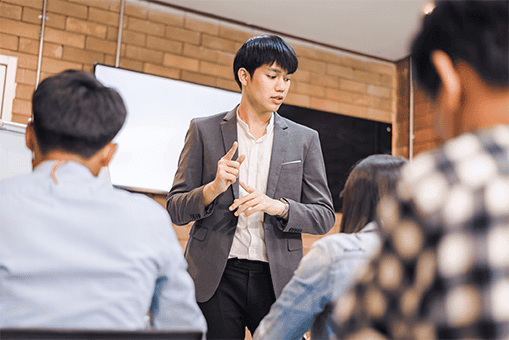
Become a Powerful Communicator
Research has proven that the most impactful skill for a leader to have in times of change or challenge is the ability to communicate powerfully. However, very few leaders have mastered it.
Participants take a self-assessment to help them understand their natural inclinations when it comes to communicating with others, learn the five behaviours that will significantly improve their ability to communicate with impact, and receive a development tool to help them create an action plan to communicate powerfully.

Inspiring High Performance
The research is clear that a leader’s ability to inspire and motivate others is the best predictor for employee commitment and satisfaction at all times. Yet, it is the behaviour that leaders struggle with the most.
Participants take a self-assessment to understand their natural inclination for pushing or pulling others, learn the six behaviours that highly inspirational leaders use to motivate others, and create a personally relevant plan using a research-based development tool to improve their ability to inspire those they lead.

Bold Leadership™
In today’s complex world, leaders must boldly take on new goals, challenge the status quo, and push boundaries.
Participants will apply a simple, practical approach to improve their ability to influence others, and determine specific steps in order to lead boldly in a complex and dynamic environment.

The Trifecta of Trust™
In times of heightened stress and uncertainty, people need to trust their leaders more than ever. However, understanding how to earn or establish trust perplexes many leaders.
Leveraging the results from their self-assessment, participants learn how they can increase trust for themselves and their teams and utilise development tools to create a plan to raise the level of trust they establish with others.

Leadership Speed™
As work environments change, leadership speed is required for today’s highly effective leaders. Research shows that a leader’s abilities to execute fast and right will dramatically improve an organization’s results.
Participants will learn the key behaviours that will help them navigate the demand for greater agility, innovation, and pace, take a self-assessment to identify their personal preferences across three spectrums directly correlated to leadership speed, and receive a development tool to help them lead with speed.
Communication and Collaboration

Build Your Resilience
Highly resilient leaders are proven to not only survive, but thrive in times of change or challenge.
Participants receive personal insights on how they currently approach their work and are given specific, data-supported ways to develop this skill. They leave the session with a individualized plan focused on improving leadership resilience.

Build Your Leadership Agility
Leaders with strong learning agility can thrive in unpredictable and rapidly changing times.
Participants learn new ways to navigate a changing environment and the four skills to successfully advance one’s ability to respond to change. They also discover new ways to navigate a changing environment.

Strategic Thinking
Strategic thinking is an essential component of leadership—and one of the most difficult competencies to acquire.
Participants will be shown compelling data that shows strategic thinking as a critical competency for long-term career advancement. They are also asked to consider why strategic thinking is critical for their functional role today. They receive personal insights on how they currently approach their work and are given specific, data-supported ways to develop this skill. Participants leave the session with a individualized plan focused on improving this key leadership competency.
Collaborative Leadership
As a CEO, you wish you had a more collaborative and synergised organisation, do you? However, many managers are overwhelmed with poorly planned meetings, ineffective team events, and a flood of emails seeking information and assistance - and that’s how organisations become dysfunctional.
Zenger Folkman measures each participant’s tendency to act independently or interdependently, and offers four companion behaviors that enable leaders to work more collaboratively. Each participant will create a personal development plan for improvement.
Leadership Agility and Team Empowerment

Solve Problems: Faster, Smarter, Better
Problem solving is almost always ranked by leaders as one of the top four most important leadership skills. With focus in the right areas, this skill can be developed.
Participants examine the skills associated with problem solving, and learn the steps to ferret out problems and analyse issues. The optimum steps in the solution process are revealed and a process for creating a development plan is introduced.

Setting Stretch Goals
Employees have reported higher engagement and satisfaction from working on challenging assignments. However, some leaders protect their employees from difficult projects while others challenge employees to tackle lofty stretch goals.
Participants will learn the advantages and complexities of high development targets and
analyse the barriers faced by organisations and managers. They will discover four proven skills for successfully establishing stretch goals, and leave with a focused development plan for improvement.

Developing Others
In every successful organisation today, leaders must have the skills to help people reach their full potential as employees want opportunities for growth earlier in their careers.
Participants will discover the five researched behaviours that empower leaders to develop others. They are presented with three data-driven approaches for developing others and take a self-assessment to discover which of the three approaches is a good fit for their development style. Then, using our unique guide, they create an action plan focused on developing one of the five crucial behaviours.

Building Relationships
We spend majority of our lives at our workplace - a critical place for developing meaningful connections. Leaders who develop more positive relationships report significantly better employee engagement, retention, and discretionary effort.
Leaders assess their strengths and approach to connecting with others. They discover what exceptional relationship-builders do. And they create a development plan selecting from a precise set of strength-building behaviours that are proven to improve relationships.

Taking the Initiative
Initiative has been proven to help leaders persist in the face of difficulty and see any project or idea through to a successful conclusion. Every team and organization benefits from leaders who know how to inspire initiative as it spurs productivity and drives results.
Participants assess their personal initiative barriers and growth opportunities, learn about the research we’ve gathered on expanding initiative, and put together a plan for utilizing six strength-building behaviours to develop initiative.

Valuing Diversity
Zenger Folkman’s research shows that 25% of leaders are completely unaware if they possessed racial, age, gender, or other biases.
Participants will learn the five critical skills to help leaders communicate that they genuinely value diversity and inclusion, and create a development plan to facilitate improvement based on insights.
Strategic Thinking and Innovation

Innovative Leadership
New processes, ideas, methods, and approaches are critical to the continuing success of any organization. Organizations need innovative leaders who recognize the importance of fostering a culture from which innovation emerges. Indeed, peak levels of innovation are dependent on the quality of leadership in an organization.
Leaders complete a self-assessment that identifies their preferences and effectiveness at innovation. They learn the five strength-building behaviors for innovation, receive a development guide, and create an action plan for targeted growth in these areas.

Results-Driven Leadership
Research from over 100,000 managers revealed that displaying behaviours directly correlated with the ability to get things done was at the top of the list of critical competencies for direct reports. These behaviours allow leaders to increase their focus, clarify priorities, and ignite their initiative.
Participants will complete an assessment to identify their preferences for balancing relationship building and achieving results. They will discover six strength-building behaviours for successfully driving results, and receive specific insights to create a development plan to facilitate growth.

Generating Energy
After years of turbulent work environments, employee burnout is high, and well-being is essential.
Participants will explore the research behind the causes of “quiet quitting” and understand the leadership behaviours that can motivate and energise the individuals they manage.

Transforming Expertise Into Extraordinary Leadership
A leader’s ability to retain expertise as they move up the chain of leadership fosters greater trust, speed, and good judgment. So how can leaders leverage their technical expertise to become Extraordinary Leaders?
Participants will explore how to leverage expertise in leadership roles, identify behaviors that will build strength in demonstrating professional acumen, and understand the importance of demonstrating technical expertise throughout their careers.

Leadership Essentials — Integrity and Honesty
Being among the highest-ranked competencies for leaders to have, demonstrating high levels of integrity and honesty is about more than telling the truth. It includes behaving consistently and having the confidence to engage honestly with others.
Participants will explore the specific behaviours that demonstrate honesty and integrity.
Resilience, Change and Adaptability

The Art of Making Decisions
Your decisions are the building or stumbling blocks of your career. Because of this, many people tend to avoid making difficult decisions. Our research shows that there’s a powerful correlation between decision-making and the ratings of overall leadership effectiveness.
Participants assess their strengths and approach to making decisions. They are shown research on how their decision-making process impacts their direct reports. Participants receive a development guide and create an action plan based on the strength-building behaviors proven to help leaders make decisions more effectively.

Strengthening Your External Focus
Studies of the past decade show customer satisfaction has dropped dramatically while demands have increased. Balancing the growing requirement for external focus while managing internal organizational needs is challenging. So, how can leaders sustainably improve their connection to customers and create an experience that inspires loyalty?
Leaders assess their ability to connect with customers’ needs and competition in the outside world. They discover the five strengths that empower leaders to meet customer demands and maintain loyalty and create a development plan to balance their internal and external focus effectively.

Leading Change
70% of companies have experienced significant shifts—such as serious downsizing, explosive growth, or a merger—in the last 2 years. While leaders are responsible for driving change, they often lack the formal preparation or skills to facilitate change in their organization.
Participants will discover how to overcome inertia using the strength-building behaviours that empower them to be effective champions of change in their leadership roles. They receive a development guide and make an action plan for focused improvement.

Risk-Taking Leadership
Organisations seek bold leaders who willingly take risks and potentially reap great rewards, so it pays to develop the skills that strengthen success and stability.
Participants will complete a self-assessment to understand their willingness to assume risk. They discover the strength-building behaviours that build the confidence and skills to improve risk-taking. And they create a development plan for targeted growth in these crucial behaviours.
Testimonials


Novelty BizCentre,
18 Howard Road, #09-01,
Singapore 369585
Novelty BizCentre,
18 Howard Road, #09-01,
Singapore 369585
+65 6346 1455
enquiry@lifeskillsinstitute.sg
Copyright 2026 LifeSkills Institute. all rights reserved.